Most contractors don’t lose money on public projects due to poor strategy. They lose it because something they didn’t fully understand shows up mid-project and quietly starts eroding their margins.
Prevailing wage is one of the most common sources of that risk. It is not just a compliance requirement sitting in the background. It directly affects how you structure payroll, manage subcontractors, handle reporting, and ultimately protect your project’s profitability. Without clear systems in place, it quickly turns from something manageable into something reactive.
That is where the pressure builds. You are trying to keep the project moving, stay on schedule, and deliver profitably while navigating requirements that can feel unclear or constantly shifting. And when something is missed, the consequences are not small. Back wages, fines, audits, delays, and even the loss of future bidding opportunities can follow.
The challenge is that most of these issues do not come from intentional mistakes. They come from gaps in process, lack of clarity, or systems that were never designed to handle prevailing wage requirements in the first place.
What matters is having a clear understanding of where risk actually shows up and putting the right structure in place before it becomes a problem.
If you are bidding or managing public projects and want to avoid margin erosion, delays, and compliance risk, this is the moment to get clarity:
What Prevailing Wage Laws Mean for Your Colorado Infrastructure Projects
Definition and Purpose of Prevailing Wage
Prevailing wage establishes the standard hourly compensation, including benefits, paid to workers in a specific job or trade within a region. This rate combines basic hourly pay with fringe benefits: medical care, pensions, vacation pay, and apprenticeship program contributions.
The wage floor protects local compensation standards. Government contracts cannot undermine marketplace rates by requiring contractors to match geographic locality and occupation standards.
Colorado’s system covers construction workers beyond mechanics and laborers, providing broader workforce protection. Wages must account for:
- Unemployment benefits
- Life insurance
- Disability coverage
- Other bona fide fringe benefits
Important limitation: Benefits that employers must provide by law, such as workers’ compensation or unemployment insurance, don’t count toward prevailing wage calculations.
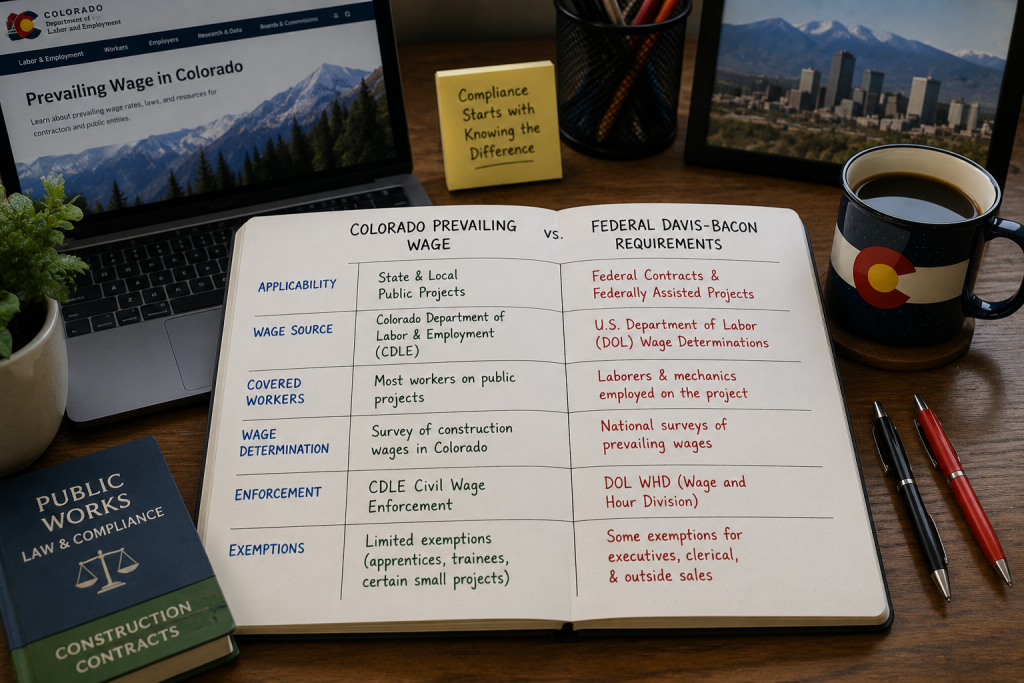
Federal vs. State Prevailing Wage Requirements
The Davis-Bacon Act governs federally funded projects. Any contract exceeding $2,000 for the construction, alteration, or repair of public buildings or public works triggers compliance. Federal law covers mechanics and laborers, with wage rates determined by the U.S. Department of Labor.
Colorado’s prevailing wage law applies to state-funded public projects valued at $500,000 or more. This higher threshold means smaller state projects escape compliance requirements, while modest federal projects still require adherence.
Colorado law encompasses “other construction workers” beyond mechanics and laborers. The state definition includes improvements, demolitions, operation contracts, upkeep of completed projects, and all public improvements, including roads.
How Colorado Infrastructure Funding Triggers Compliance
Public projects include construction, repair, improvement, or demolition of buildings, roads, structures, facilities, highways, and bridges. Energy sector public works projects and thermal energy network systems also fall under the requirements.
Compliance triggers when:
- Private parties contract with government agencies
- The state will rent, lease, or purchase at least fifty percent of the project
Your weekly obligations:
- Pay wages weekly to all employees working directly on the project site
- Enter and certify payroll data through the LCPtracker system
Know Exactly Which Projects Require Compliance
Project Value Thresholds You Need to Track
State-funded public project contracts of $500,000 or more trigger Colorado prevailing wage requirements for you and every subcontractor on your project. Projects below this threshold escape state obligations.
Colorado Department of Transportation operates differently. CDOT projects follow Davis-Bacon Act requirements regardless of project value or funding source. Federally funded construction projects trigger Davis-Bacon prevailing wage when contracts exceed $2,000.
Public Project Types Under Compliance
Your project qualifies when it involves the construction, repair, improvement, or demolition of buildings, roads, structures, facilities, highways, and bridges. Operations or upkeep contracts for public improvements also require compliance. Private work qualifies when government agencies will rent, lease, or purchase at least fifty percent of the project.
Thermal energy network or system projects need compliance when estimated contract costs reach $500,000 for prevailing wage and $1 million for apprenticeship requirements.
Energy Sector Compliance Thresholds
Power generation projects with a nameplate capacity of one megawatt or higher require compliance when receiving $500,000 or more in aggregated state assistance. Energy storage systems with one megawatt of power capacity or four megawatt hours of usable energy capacity follow identical thresholds [1].
Additional energy projects – pollution controls, utility gas distribution, electric transmission, geothermal systems, EV charging infrastructure, hydrogen-related construction, and carbon dioxide transport or storage must comply when total project costs exceed $1 million and aggregated public assistance reaches $500,000.
Projects That Escape Colorado Requirements
Projects receiving federal funding follow federal Davis-Bacon standards instead of Colorado-specific requirements. Energy sector projects covered by Project Labor Agreements – prehire collective bargaining agreements between lead contractors and construction labor organizations – are exempt from Part 3 prevailing wage and apprenticeship reporting.
Other exemptions include work performed by utility company employees, projects satisfying federal Inflation Reduction Act requirements, utility-incentivized demand-side management programs, building energy efficiency programs, service agreements executed before March 1, 2023, electric distribution lines with a capacity of 69 kV or less, and pipelines with specified minimum yield strength below 30%.
Essential Compliance Requirements for Your Project
Weekly Payment Obligations to Workers
You must pay all employees working on prevailing wage projects weekly by check or direct deposit. Wages cover every hour worked on site, with payments made without subsequent deduction or rebate, except those required by law.
Certified Payroll Records and Reporting
Submit certified payroll records electronically using LCPtracker, the web-based software system. Records must go in weekly for each week any contract work is performed. Each payroll includes:
- Worker names and identifying numbers
- Classifications and hourly wage rates
- Daily and weekly hours worked
- Deductions and actual wages paid
Prime contractors review and approve subcontractor data before project managers accept the monthly payroll.
Fringe Benefits and Wage Determinations
Pay fringe benefits on standard time and overtime hours. If you offer benefit packages, get approval before offsetting the fringe portion listed in wage determinations. Benefits must be guaranteed and irrevocable to qualify. Wage determinations are updated twice yearly in January and July.
Apprenticeship Program Requirements
Apprentices must hold a current certification from the U.S. Department of Labor. You enforce a 1:1 ratio – one apprentice maximum per journeyman performing the same craft. Out-of-ratio apprentices receive journeyman wages.
On-Site Documentation and Posting Requirements
Display wage rates, wage-theft posters, and prevailing-wage posters in accessible job-site locations. Maintain on-site logs tracking every employee’s name, job title, and employer.
Protect Your Business: Understanding the Real Costs and Consequences
The Truth About Project Costs
Your assumptions about prevailing wage costs may be wrong. 77 percent of peer-reviewed studies examining contractor bids found that prevailing wage standards don’t increase costs. When researchers focused specifically on schools and highways, 1 percent of studies show no cost increase.
Higher wages get offset by greater productivity – skilled workers perform approximately 20 percent more efficiently than less skilled counterparts. All studies examining bid competition found that prevailing wage doesn’t reduce the number of bidders. Remember: wage costs represent only one-third of overall construction expenses.
Why Local Contractors Benefit
Prevailing wage protects your market position by keeping jobs, income, and spending within project areas. Studies examining construction in California, Minnesota, Indiana, and Iowa found more work completed by local contractors when the prevailing wage applies. Projects without wage standards saw increased work by out-of-state contractors.
Penalties That Can Destroy Your Business
Willful violations trigger escalating fines:
- $5,000 for first violations
- $10,000 for second violations
- $25,000 for third and subsequent violations
Courts must award double the underpayment amount plus interest. Contractors with three or more willful violations within five years face debarment for up to three years.
Even minor infractions cost you. Failure to respond to Division notices results in $250 fines.
When Complaints Hit Your Project
Employees file complaints with the contracting agency first. Agencies review payroll records and allow 15 days for correction if an administrative error occurred. Willful violations or uncorrected issues get reported to DLSS for investigation. The Division investigates all reported violations and may require wage restitution plus fines.
Protect Your Business. Secure Your Profitability.
Prevailing wage compliance is not just about meeting requirements. It is about protecting the foundation of your business while you pursue higher-value opportunities.
Every public project puts pressure on the same three priorities: maintaining your margins, keeping work on schedule, and avoiding unnecessary risk. When compliance is unclear or handled reactively, all three become harder to control. Small gaps in the process can quickly turn into financial exposure, operational disruption, and long-term damage to your ability to compete for future work.
The contractors who consistently succeed in this space approach compliance differently. They do not treat it as a box to check after the fact. They build it into how the project operates from the beginning, with clear processes, defined responsibilities, and systems that support accurate execution.
When that structure is in place, everything changes. You gain confidence in your numbers, reduce the likelihood of costly corrections, and position your business to take on more public work without hesitation. Just as importantly, you remove the constant uncertainty that slows down decisions and creates unnecessary stress across your team.
The reality is that many companies are still trying to manage prevailing wage requirements with fragmented tools and manual processes that were never designed for this level of complexity. That is where risk builds over time, often without being fully visible until it is too late.
You do not need to operate that way.
If you are planning, bidding, or actively managing public projects, this is the right moment to step back and clarify where you stand.
We will help you simplify compliance, strengthen your processes, and protect the profitability of your projects without adding unnecessary complexity.
Because when you have clarity and control, you are not just avoiding risk. You are creating the foundation to grow with confidence.