
What happens to your margins when one prevailing wage detail gets missed across an entire project?
Oregon prevailing wage requirements are not just another compliance layer. They directly affect how you bid, run payroll, and manage subcontractors. With BOLI enforcement, certified payroll deadlines, and rate updates throughout the year, even small gaps can turn into back wage liability, retained payments, or penalties that impact your cash flow.
The challenge is not awareness. It is execution. When processes are unclear or handled manually, mistakes in classification, rate selection, or reporting deadlines become very costly very quickly.
This guide walks through how Oregon’s prevailing wage system actually works so you can avoid those gaps and stay in control. If you want to identify where your current process may be exposed, book a working session to get clarity and protect your margins.
We can help you protect your profitability while confidently managing prevailing wage rates on every public works project.
What is Prevailing Wage in Oregon and Why It Matters
Oregon’s Prevailing Wage Rate Law Explained
Oregon passed the prevailing wage rate (PWR) law in 1959, earning it the nickname “Little Davis-Bacon Act” because it modeled itself on federal wage protections. The law operates under Oregon Revised Statutes Chapter 279C.800-279C.870, establishing minimum compensation standards for workers on publicly funded construction projects.
Oregon’s prevailing wage requirements mandate that contractors pay workers standardized wages that reflect local labor agreements for similar work. The Bureau of Labor and Industries (BOLI) administers and enforces the PWR law, handling rate determinations, contractor education, and violation investigations.
How BOLI Prevailing Wage Protects Workers and Contractors
The dual protection model serves both workforce and business interests. Oregon designed the PWR law to ensure contractors compete on their ability to perform work competently and efficiently while maintaining community-established compensation standards. The system prevents a race to the bottom where contractors undercut each other by paying substandard wages.
For workers, BOLI prevailing wage protection prevents exploitation through established base hourly wages and fringe benefits. For contractors, the law creates fair bidding conditions where your competitive advantage comes from operational excellence, not wage cutting.
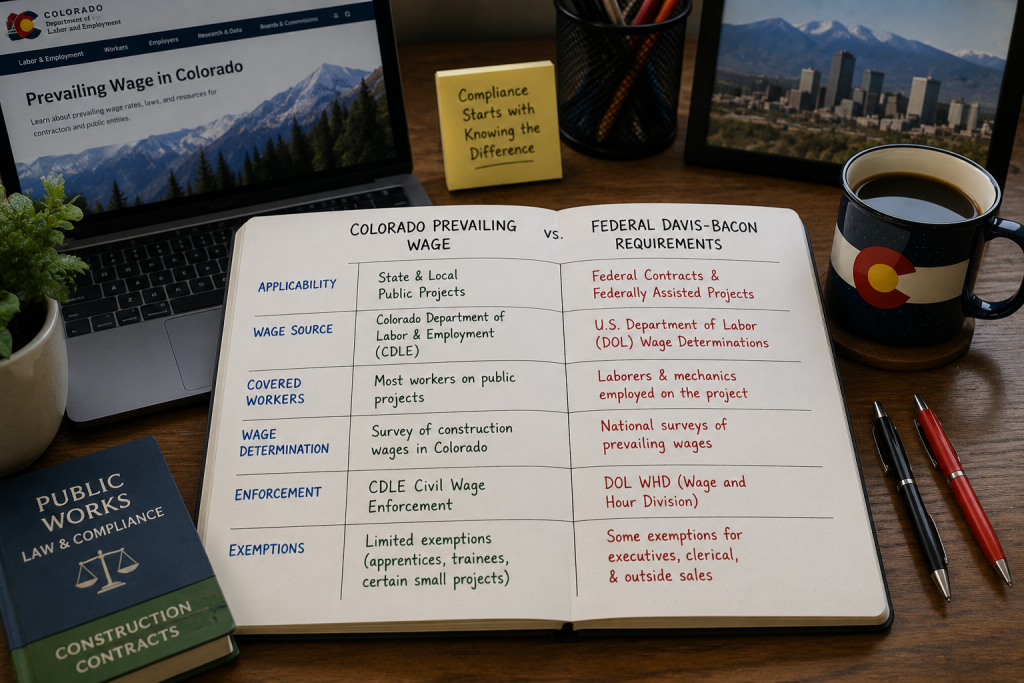
Federal Davis-Bacon Act vs Oregon Requirements
You need to distinguish between federal and state systems. The Davis-Bacon Act applies to federally funded projects exceeding $2,000, while Oregon’s PWR law covers state-funded projects over $50,000 for major renovations.
Projects with mixed funding often require compliance with both frameworks, where contractors must pay the higher applicable rate. One critical difference: BOLI publishes new prevailing wage rate books on January 1 and July 1 each year, with additional amendments on April 1 and October 1. This semi-annual update keeps Oregon’s prevailing wage rates more current than many states that update only annually.
Which Projects Trigger Prevailing Wage Compliance
Public works projects include:
- Construction, reconstruction, major renovation, or painting carried on or contracted for by a public agency
- Projects using $750,000 or more in public funds
- Privately owned projects where 25% or more of the square footage will be occupied by a public agency
- Solar energy installations on public property, regardless of cost
Demolition work preparing for planned construction falls under PWR law, as does warranty work on covered projects.
Oregon Prevailing Wage Rates and Project Requirements
Understanding the $50,000 Project Threshold
The $50,000 threshold applies to total project cost, not individual contracts. This includes all work performed by every person paid by a contractor or subcontractor, plus materials and supplies purchased specifically for the project.
Critical point: If your project starts under $50,000 but change orders push the total above this threshold, the entire project becomes subject to PWR law retroactively. This catches many contractors with unexpected compliance costs.
How Oregon Determines Prevailing Wage Rates
Oregon uses comprehensive statewide construction industry surveys rather than relying solely on collective bargaining agreements. BOLI gathers wage data directly from contractors, subcontractors, and collective bargaining representatives across Oregon. The Labor Commissioner analyzes this survey data alongside local collective bargaining agreements and actual wages paid on similar projects.
Rate Structure: Base Wages Plus Fringe Benefits
Each prevailing wage rate has two components: hourly base rate plus hourly fringe rate.
Example: A carpenter earning $42.50 per hour base wage plus $18.75 in fringe benefits totals $61.25 per hour.
You can meet fringe benefit obligations by providing actual health insurance, pension plans, and other qualified benefits that equal or exceed the fringe amount, or pay the fringe portion directly in cash.
Rate Lock-In for Cost Certainty
Rates in effect when bid specifications are first advertised apply for your entire project duration. This protects you from unexpected rate increases during construction.
Finding Current BOLI Rates
BOLI publishes new rate books twice yearly: January 1 and July 1. Additional amendments appear April 1 and October 1.
To find the correct rate, you need three pieces of information:
- Date your project was first advertised for bid
- County location
- Specific worker duties
Critical Compliance Requirements for Oregon Contractors
Paying the Correct Prevailing Wage Rates
Pay workers based on actual work performed, not job titles. If a worker classified as a laborer performs electrical work, you must pay the electrician’s rate for those hours. Partners performing worker duties must receive prevailing wages for time spent on manual tasks.
Certified Payroll Reporting and Monthly Deadlines
Submit certified payroll reports using BOLI’s WH-38 form by the fifth business day of each following month. FederalWH-347 forms do not meet Oregon requirements. Missing this deadline triggers automatic 25% retainage of amounts due until you submit compliant reports.
Worker Classification and Job Categories
Workers spending more than 20% of their time on manual or physical duties during any workweek must receive prevailing wages. Administrative, executive, professional, supervisory, or clerical duties do not trigger coverage.
Apprenticeship Requirements and Ratios
Apprentices must be registered with BOLI-approved programs. If you exceed the apprentice-to-journeyman ratio permitted in program standards, all excess apprentices must be paid the full journeyman rate.
Managing Subcontractor Compliance
You bear responsibility for subcontractor compliance. Verify first-tier subcontractors file certified payroll reports, or withhold 25% of their payments. Senate Bill 426 establishes joint and several liability for unpaid wages throughout the subcontracting chain.
Public Works Bond and Registration Requirements
File a $30,000 public works bond with the Construction Contractors Board before starting work. This bond covers wage claims ordered by BOLI. Verify all subcontractors maintain current bonds before permitting them to start.
Penalties, Risks, and How to Avoid Costly Violations
Financial Penalties and Back Wage Liability
BOLI civil penalties reach $5,000 for each violation. Willful violations of ORS 279C.305 trigger $20,000 penalties. You also face back wage liability covering all underpaid amounts plus interest.
Oregon Senate Bill 426 creates joint and several liability for unpaid wages throughout your subcontracting chain. You remain liable even after paying subcontractors in full. This means paying twice for the same work.
Debarment and Loss of Bidding Rights
BOLI can debar contractors for three years if they intentionally falsify certified payroll statements. Debarment blocks you from receiving public works contracts or subcontracts. Prime contractors face debarment even when subcontractors commit violations.
Common Compliance Mistakes Contractors Make
Worker misclassification creates the most frequent underpayment violations. Other compliance gaps include:
- Using outdated wage rates
- Missing certified payroll deadlines
- Failing to maintain apprentice-to-journeyman ratios
- Improperly documenting fringe benefits
- Inadequate recordkeeping
Best Practices for Staying Compliant
- Check BOLI and Davis-Bacon updates regularly
- Use certified payroll software to automate wage calculations and report submissions
- Conduct internal payroll audits before submission
How Compliance Partners Protect Your Business
Compliance experts prevent payment delays and improve your bid acceptance rates. Contractors with proven compliance records win more contracts and maintain stronger reputations.
Conclusion
Oregon prevailing wage compliance is not just about following rules. It is about maintaining control over your payroll, your subcontractors, and your overall project risk.
When compliance is reactive, issues show up late in the form of penalties, withheld payments, or back wages. When it is structured, it becomes part of how you protect profitability and operate with confidence across every public works project.
You do not need to guess your way through rate changes, reporting requirements, or subcontractor oversight. You need a system that holds up under real conditions and keeps everything aligned from bid to closeout.
We help contractors like you build compliance records that create competitive advantages. With proper processes, you can confidently bid on public works projects while maintaining the profitability that keeps your business growing.