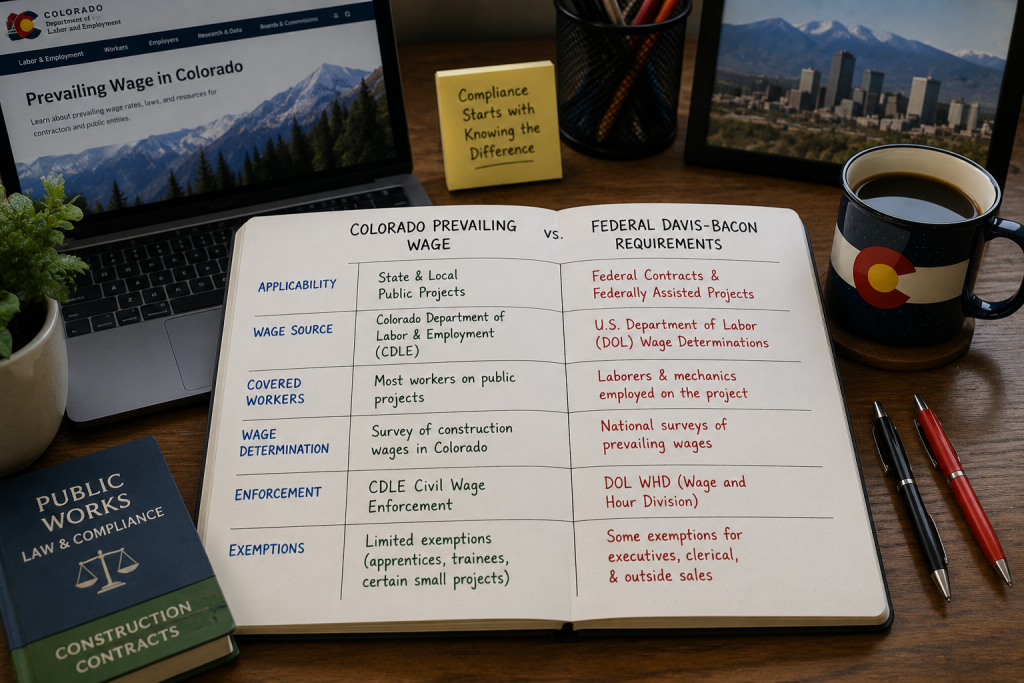

If you are bidding on or delivering infrastructure projects in Colorado, prevailing wage compliance is not something you can treat as a formality. It directly affects your labor costs, your margins, and your exposure to penalties if handled incorrectly.
What makes Colorado particularly complex is the layering of requirements. State law, local ordinances, and in many cases federal rules can all apply to the same project. A single contract may require you to align multiple wage determinations at once, and even small missteps can result in back pay, fines, or delays.
At the state level, Colorado’s Prevailing Wage Act requires contractors on public works projects funded by the state or local governments above certain thresholds to pay wage rates set by the Division of Labor Standards and Statistics (DLSS). These rates vary by county and classification and are updated periodically based on wage surveys.
At the local level, the City and County of Denver enforces its own prevailing wage ordinance under Section 20-76 of the Denver Revised Municipal Code. This applies to city-funded construction contracts of $2,000 or more and requires contractors to follow wage determinations issued by the Denver Auditor’s Office, including weekly certified payroll reporting.
In many cases, federal requirements under the Davis-Bacon Act also apply when federal funding is involved. The Act requires payment of locally prevailing wages on federal construction contracts exceeding $2,000 and is enforced by the U.S. Department of Labor.
The result is that many projects in Denver operate under multiple overlapping wage frameworks. Contractors are expected to identify all applicable requirements and apply the highest or most stringent standards across classifications, documentation, and reporting.
This guide gives you clear, practical insight into how these requirements intersect, where Colorado and Denver rules differ from federal standards, and what those differences actually mean for your bids, payroll, and day-to-day compliance decisions.
The goal is simple: help you avoid costly compliance issues, protect your margins, and approach infrastructure work in Colorado with confidence and control.
Schedule a Denver & Colorado compliance review to validate your wage classifications, payroll processes, and bid assumptions, so you can avoid costly mistakes, stay audit-ready, and protect your margins on every public project.
Colorado infrastructure compliance basics
Colorado Prevailing Wage Act (CPWA). State projects over $60,000 in public funds (schools, universities, etc.) must pay prevailing wages set annually by the Colorado Division of Labor Standards and Statistics. These rates vary by county and occupation and are updated whenever new surveys are published (often semiannually). Colorado’s rules emphasize that the “prevailing wage” is the minimum total wage (including fringe) for the craft in that area. Colorado law also has strong enforcement: willful violators face fines up to $25,000 per incident and debarment up to three years.
Denver’s ordinance. Under Denver’s Rev. Mun. Code §20-73, any Denver contract (or contract funded by Denver) of $2,000 or more for construction/renovation requires pay not less than Denver’s prevailing wage. Denver maintains its own rates for Building, Heavy/Highway, and Residential categories, plus an “Administrator” classification for general labor. These are posted by the Auditor’s Office (City Auditor’s Prevailing Wage website). For example, Denver’s Building wage determination lists current base rates and required hourly fringes for carpenters, electricians, etc. Denver’s ordinance also strictly requires payment via weekly certified payroll and posting the schedule at job sites.
Implication for contractors: Any contractor bidding on a City of Denver infrastructure project must incorporate the Denver wage rates. For projects that involve both Denver and state funding, the highest applicable rates govern: if Denver’s wage for a craft is higher than the state’s, you must pay the Denver rate. Document everything carefully. For instance, if bidding on a Denver school building addition funded partly by city bonds and partly by state education funds, use the higher Denver rate for each trade. As a key step, always identify the correct zone and classification in the Denver determinations, and double-check the county for state rates. Denver also requires supervisors and foremen to meet the same rates with fringes; misclassifying can cause fines.
Denver-specific compliance risks
Denver projects face a few unique pitfalls:
- Dual coverage. On many projects, both Denver and Colorado law might apply (plus federal). If federal funds enter, Davis-Bacon applies too. When multiple laws attach, use the strictest wage/rule. Example: A Denver street project with federal transit funds requires Davis-Bacon wages, which might have a higher base plus separate fringes; Denver still requires a minimum base = its own minimum wage (Denver’s code) plus its fringe. Compliance paperwork must satisfy all requirements simultaneously.
- Annual updates. Denver’s rates change over time. The Auditor’s Office issues modifications (e.g. buildings in Feb 2026). Failing to use the latest published rates can trigger back pay. Contractors should subscribe to Denver’s Prevailing Wage site or utilize payroll software (like LCPtracker) that auto-updates.
- Certified payroll specifics. Denver generally requires a weekly certified payroll (Denver form or WH-347) signed by the contractor’s officer. Unlike some jurisdictions that allow quarterly or biweekly reporting, Denver audits actual weeks worked. A common violation: late or incomplete payroll reports. Fix: require foremen to submit daily timesheets keyed to the project, and enter them into your certified payroll system by Friday each week.
- Local classifications. Denver has a “Concrete Finisher (Crusher Lot)” category that Colorado state doesn’t have. If your crews perform concrete work, ensure they are classified correctly. Similarly, Denver’s “Mason Tender” is distinct. Misclassification here can lead to 2nd (usually higher) choice enforcement.
- Minimum wage overlay. Denver’s prevailing wage for many crafts is set so that the base wage is at least the City’s minimum wage (e.g., the Building Laborer base wage of $21.95 matches Denver’s $21.95 minimum). This means no paycheck can slip below the citywide minimum base. A compliance trap: paying a worker ‘just above’ minimum under a lower classification is illegal. Always ensure base pay meets the classification’s published figure.
Colorado vs. federal wage differences
Colorado’s rules differ from federal Davis-Bacon in key ways:
- Fringe incorporation: Federal law (DBA) often allows cash-in-lieu for fringes, whereas Colorado typically mandates the total prevailing package. For example, if the Colorado survey says a Carpenter’s total is $40/hr with $10/hr fringe, you must pay $30 base + $10 fringe (or $40 base with no fringe), not $40 base plus a separate fringe. This is stricter than federal.
- Rate choice: Under Davis-Bacon, Colorado projects (with federal money) can often opt for either state or federal determinations. But Denver’s ordinance says: whichever is higher. So if Davis-Bacon lists $30 base/benefits, and Denver lists $32 base, you pay $32 base.
- Thresholds: Davis-Bacon kicks in on federal contracts > $2,000. Colorado’s trigger is $60,000 for state-funded projects. Denver’s is $2,000 for city contracts. So a $10,000 Denver local park renovation needs coverage; a $10,000 state building renovation does not.
- Enforcement & Debarment: Feds debar contractors for prevailing wage violations, and fines can be unlimited per violation. Colorado law (C.R.S. 24-92-203) imposes fines up to $25k per willful underpayment, and up to 3-year debarment. Denver’s Auditor can fine and may also recommend debarment.
Example scenario:
A contractor is bidding on a Denver-aided highway project. It has $1M in federal funds, $500k in state funds, and $500k in city funds. Here, Davis-Bacon applies (federal portion), Colorado law applies (state portion), and Denver ordinance applies (city portion). The contractor finds Denver’s rates are the highest for carpenters. They must pay the Denver base ($–hour) plus the Denver fringe ($–hour) each hour. They complete WH-347 weekly and note the combination of laws in the remarks. During the bid phase, they add a compliance consultant fee or tool subscription to their overhead to manage this complexity.
Local funding impact
Colorado has received significant IIJA and state infrastructure funding in recent years, supporting roads, bridges, water, and building projects. Denver alone has an annual Capital Improvement Program (CIP) budget exceeding $400 million, including voter-approved bonds for roads and transit. Such funding surges mean that many projects will carry prevailing-wage triggers. Contractors should watch budget announcements (Denver DOTI website) for project timelines and plan staffing/training accordingly. For example, if Denver announces $50M in new bridge work in April, expect formal bids and wage requirements to be published in the coming months.
In short, more infrastructure funds = more prevailing wage contracts. This drives increased demand for compliance help. It also magnifies risk: with big programs like Elevate Denver Bonds or CDOT highway expansions, non-compliance penalties can reach six figures. Proactive compliance planning (pre-bid checklists and early training) is now as important as estimating rebar costs.
City vs state requirements
Denver and state laws sometimes diverge. Contractors must treat them separately:
- Wage rates: Denver uses city-based rates (often equal or above state). Example: Denver’s Bricklayer base might be $23; Colorado state (four-county average) might be $20. If you work on a Denver-funded project, you follow Denver’s $23. If state-funded, follow the surveyed state rate.
- Apprenticeships: Colorado law mandates that certain trades (electrician, plumber, etc.) use registered apprentices (and counts their hours) on large projects. Denver’s ordinance is silent on apprenticeships, but federal IRA rules require it on federally assisted projects. Essentially, the strictest apprenticeship rule applies. So on a state DOT job, ensure your subs are apprenticeship-program-participating if those trades are involved.
- Reporting: Both require weekly certified payroll (OR WH-347). Colorado statute explicitly requires contractors to submit certified statements to the contracting agency’s designee. Denver similarly requires weekly certification to the Auditor. A contractor working on both state and city-funded portions may need to file two sets of paperwork (one to state auditor, one to city auditor).
- Violations: If a Denver project also has state funding, a citation could come from Denver’s Auditor or the Colorado Division of Labor Standards. Always err on side of conservative interpretation to avoid cross-enforcement.
Contractual trick: Many Denver projects are “federally assisted” through FHWA or transit funds. In practice, contractors often list all applicable laws on their subcontract and bidding documents (e.g. “This contract is subject to Davis-Bacon, Colorado PWA, and City of Denver Prevailing Wage Requirements.”). Making this explicit in bid docs avoids claims of “I didn’t know.” It’s also common to embed a compliance clause requiring subs to submit weekly certified payroll or face back-charge provisions.
Bid preparation in Colorado
When preparing a bid:
- Identify wage determinations: Before estimating, obtain the correct state or city wage determination for each craft. Websites: Colorado DLSS Wage Determinations page and Denver’s Prevailing Wage site.
- Classifications: List all labor categories needed and match them to the proper classification (e.g. “Cement Mason” vs. “Mason Tender”). If uncertain, default to the higher classification.
- Overhead for compliance: Build in costs for compliance management (staff time, CPA software). Many contractors add ~1-2% of payroll to cover this.
- Transition period: If wage rates are set to change (e.g., July updates), clarify in bid whether the current or new rates apply. Usually, the bid uses current rates, with adjustment clauses for any rate increase after contract award (read your contract or bid spec carefully).
- Documentation: Prepare cert payroll templates ahead of time. Set deadlines for subs to provide timesheets so you can compile weekly reports.
- State licensing: Ensure all workers have Colorado licenses (some trades require registered licenses).
Example:
A contractor bids on a Denver library renovation. They list 3 Carpenters, 2 Laborers, 1 Electrician, 1 Plumber. Using Denver’s Building wage determination: Carpenter base $28, fringe $12; Electrician base $35, fringe $15; Laborer base $22, fringe $5. They calculate total labor cost at (28+12)*3 + (35+15)*1 + … per hour. In their bid, they note: “Labor costs include all applicable prevailing wage/fringe per Denver Prevailing Wage Ordinance.” This transparency helps if the owner audits the bid.
Audit risks in Denver
Denver’s Auditor’s Office periodically audits contractors for compliance. Common audit triggers:
- Misclassification: They verify each payroll entry matches the correct classification under the work performed. Studies show masonry tenders are often miscoded as laborers.
- Payroll timing: Auditors check that “week ending” dates are consistent and within allowed windows. They watch for late submissions or missing weeks.
- Crew size: If a contractor is working alone, it still must file payroll. Some think “under 2 employees, no report needed” – not true.
- Apprenticeship ratios: If one of the qualifying trades (electrical, plumbing, etc.) is present, audits check whether registered apprentices were used in required percentages on state-funded projects.
Data point: In the past 5 years, Denver has assessed over $1 million in back wages and fines via audits. The average citation penalty (including back pay) runs around 5–6 figures on major projects.
How to avoid it:
- Internal reviews: Do mock payroll audits every quarter. Cross-check jobsite sign-in sheets vs. payroll.
- Timesheets: Keep clear daily logs signed by crew. If disputes arise, a paper trail is key.
- Retain documents: Denver auditors can ask for purchase orders, invoices, or any evidence that workers were paid at the advertised rates. Keep them for at least 3 years.
- Lien waivers: Some contractors require subs to submit waivers when they file payroll, so subs can’t claim they were underpaid later.
Subcontractor compliance in Colorado
Contractor is responsible for subcontractors (prime liability). On Colorado/Denver projects, if a sub violates, the prime pays fines and back wages. Best practices:
- Prequalify subs: Only use subcontractors with proven compliance histories. Check references.
- Flow-down clauses: Include clear clauses in subcontracts mandating compliance. E.g., “Subcontractor agrees to comply with Denver Prevailing Wage Ordinance (Title 20) and Colorado Prevailing Wage Act; failure results in back-charges.” This puts legal risk on subs.
- Education: Host a training meeting with all subs before work starts, explaining payroll forms and deadlines.
- Tracking: Use a standardized “Subcontractor Compliance Report” form where subs attest they paid correct wages. Collect these weekly.
- Certification: If possible, require subs to certify their payroll on Denver’s form each week. If they won’t, consider that a red flag to withhold work until they do.
Example: A prime contractor wins a Denver park job with three subs: earthwork, paving, and landscaping. The prime makes each sub attend a kickoff meeting on compliance, hands out the Denver wage sheet, and includes a section in each pay application that the sub must sign off on wage compliance. Each pay app is held for 10% retainage until that signed page comes in. This avoids post-project surprises.
Cost overruns
Prevailing wage can significantly inflate costs, and overruns often trace back to it:
- Escalating rates: If a project gets delayed, new wage determinations might raise labor costs mid-job.
- Fringe accruals: Fringe is often paid not at draw but at completion. If work goes long, fringe liabilities accumulate.
- Underestimating hours: If skilled labor takes longer, the extra hours are at higher rates, not “salaried,” so small overruns cost more than anticipated.
- Compliance fines: Violations themselves are overhead costs. For example, a $50k back pay late in a project severely squeezes margins.
To control budgets:
- Include a 5–10% contingency for labor in estimates.
- Negotiate with the owner on potential “change orders” when wage rates change.
- Monitor payroll costs weekly against budgeted amounts.
A case: On a Denver bridge rehab, a contractor thought labor was 30% of the bid. Actual: labor consumed 45% of the project cost, because specialized trades and overtime. The contractor had to absorb a loss because the owner didn’t adjust the price. Lesson: Large infrastructure tends to have higher labor percentages; plan accordingly.
Pre-construction compliance
Before shovels hit ground, take these steps:
- Identify applicable laws: For a new project, determine if it’s state-funded, city-funded, or has federal grants. This dictates which rules apply. Document this formally in your compliance plan.
- Classify work scope: Break the scope into labor categories and identify which parts are prevailing-wage tasks vs. potentially exempt. (Some equipment rental or materials might not need wage reports.)
- Set up a payroll system: If not already in place, establish a system (like LCPtracker or Procore) that can generate WH-347 or Denver forms. Enter employee data, craft codes, union/fringe info.
- Train staff: Ensure project managers and accountants know the project’s wage requirements. Provide them the relevant law snippets and links.
- Contracts: Include mandatory compliance language in prime and sub contracts now. For example, specify that subs must pay and report wages as required by law, not later.
- Community outreach (optional): For large projects, consider hosting a pre-bid meeting where compliance is on the agenda. This signals to the owner and competitors that you are serious.
By setting up compliance in pre-construction, you minimize surprises. If changes occur later (e.g., new wage determinations), you already have the baseline processes. Denver’s Auditor’s Office even offers compliance guidance to primes before a job starts – take advantage of that counseling.
Conclusion
If you have made it this far, you already know that prevailing wage compliance in Denver and across Colorado is not simple, and it is not something you can afford to get wrong.
Between state requirements, Denver’s ordinance, and federal overlays like Davis-Bacon, you are often managing multiple systems at once. Each one impacts how you bid, how you run payroll, and how you protect your margins throughout the life of a project. When those systems are not aligned, the risk shows up later in the form of back pay, fines, delays, or lost opportunities.
The contractors who succeed in this environment are not guessing or reacting. They are proactive. They build compliance into their process before the project starts, they validate their assumptions during the bid phase, and they run every job with documentation and structure that can stand up to an audit at any time.
That is where the real advantage is.
Because when you know your classifications are correct, your payroll is clean, and your process is aligned across Denver, Colorado, and federal requirements, you are not just avoiding risk. You are protecting profitability, moving faster with confidence, and positioning your business to win more public work.
If you want to make sure your current approach is actually supporting that outcome, the next step is simple.
Schedule a Denver & Colorado compliance review to validate your wage classifications, payroll processes, and bid assumptions, so you can stay audit-ready, avoid costly surprises, and move forward with confidence on every infrastructure project.