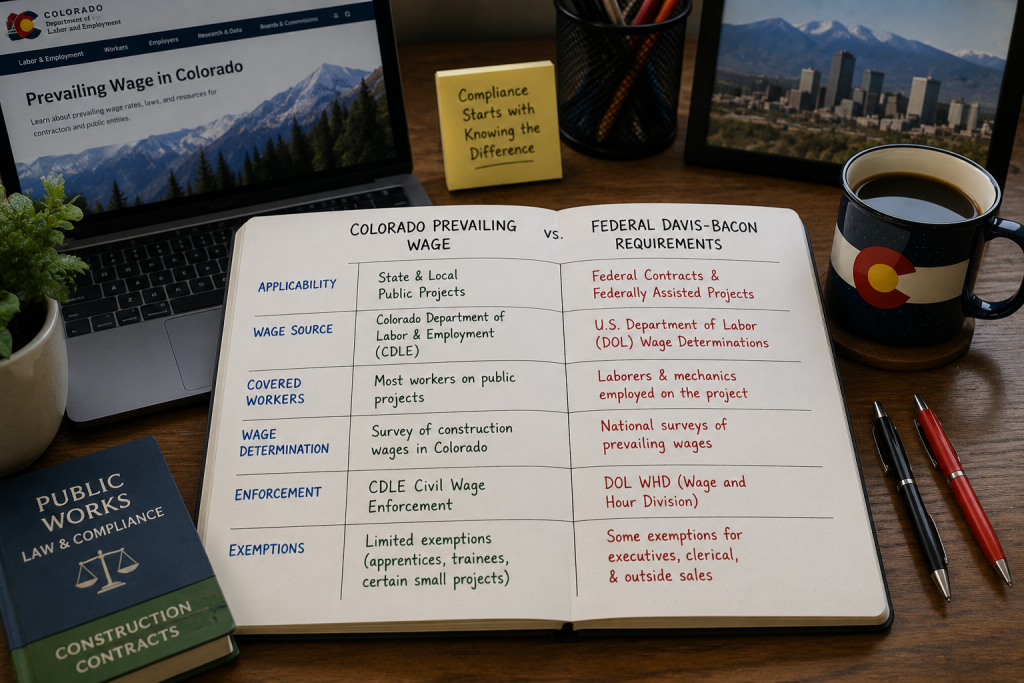
Prevailing wage rules are often thought of as a federal issue (the Davis-Bacon Act), but state and local laws add important layers. In Colorado, Oregon, Arizona, and New Mexico, projects can trigger unique requirements, especially in industries like affordable housing and renewables. This guide helps contractors, developers, and owners understand those state-specific compliance obligations. Drawing on official sources (state statutes, DOL guidance, etc.), we map out when and how these rules apply. You’ll find:
- State Law Overviews: Key details of Oregon’s wage law, Colorado’s prevailing wage act, Arizona/New Mexico statutes, etc.
- Industry Focus: How affordable housing funding and clean-energy incentives bring additional requirements (e.g. HUD Section 3, IRA prevailing wage).
- Checklists & Clauses: Practical tools for pre-bid and audit readiness (sample contract language, affidavit examples).
- Comparison Tables: Clear side-by-side tables of thresholds and reporting for OR, CO, AZ, NM, and federal rules.
- Recommendations & Visuals: Tactical tips for contractors (train your team, use software, etc.) and suggested diagrams/maps to clarify complex flows.
This articl focus on both Denver/Colorado infrastructure and broader state/industry needs. Throughout, we note when to consult our Denver/Colorado Prevailing Wage content for local insights, and suggest diving into our State & Industry cluster for sector-specific examples. By the end, you’ll be equipped to plan your project with confidence: know which laws apply, prepare the right documentation, and avoid costly mistakes.
If you are currently managing projects across multiple states, now is the right time to take a closer look.
Start by reviewing your active and upcoming projects and identifying where different funding sources or jurisdictions may be introducing additional wage requirements.
If you want a clearer, faster way to do that:
Oregon Prevailing Wage Requirements
Oregon’s labor laws require prevailing wages on most publicly-funded construction. Here’s what you need to know:
- Applicability: ORS 279C mandates prevailing wage on any public works contract over $50,000 (and $100,000 for public housing projects). This includes highways, schools, utilities, and local government projects. Note: “Public works” is defined broadly, so even school maintenance can qualify if funded by bond dollars.
- Rate Determinations: The Oregon Bureau of Labor and Industries (BOLI) publishes quarterly rate tables by region (e.g., Portland Metro vs. Willamette Valley). Each craft classification (e.g. Carpenter, Laborer) has a Type A (structural) and Type B (general) rate. The published rate is the combined wage (including benefits). Employers can pay different wage/benefit splits, but must meet the total. (Example: Q1 2026 Portland Carpenter was about $45/hr total.)
- Apprenticeship Credit: On state-funded projects, registered apprentices can count towards the workforce. Oregon allows up to 15% of labor hours to be apprentices on highway/major projects. For housing projects, specific apprenticeship obligations are less clear, but compliance plans should still track any apprentices.
- Certified Payroll: Contractors must submit weekly certified payroll reports to the awarding agency. Oregon’s form (WH-38) requires each worker’s hours, wages, and fringe benefits. It also requires a signed contractor affidavit stating compliance. It’s best practice to have your payroll software or provider generate these reports directly.
- Owner Liability: A crucial development: Oregon’s SB 426 (2023) makes property owners and general contractors liable for unpaid wages by any subcontractor. To protect themselves, owners should collect a signed statement from each sub affirming they paid the required wages. For example, our community resources include a downloadable sub-contractor affidavit template (see Appendix). Without these, owners risk being forced to pay double if a violation is found.
- Common Pitfalls:
- Fringe Shortfall: If you don’t pay enough into employee benefits, you owe the difference in cash. For instance, if the table shows $12/hr fringe but you contributed $10/hr, the extra $2 must go into wages (retroactively if needed).
- Misclassification: Labeling a skilled trade worker under a lower category (e.g., calling a painter a “laborer”) can be caught in an audit. Use BOLI’s classification list when assigning duties.
- Missing Reports: Neglecting to file payrolls on time is an easy trigger for stop-work orders. Set a firm weekly schedule (e.g. Friday afternoon deadlines) and include payroll compliance in weekly coordination meetings.
Practical Checklist (Oregon Projects):
- Identify project funding (bonds, city funds, etc.). If any public money is used, gather ORS 279C requirements.
- Download the current wage determination from Oregon BOLI (quarterly updates). Incorporate rates into bids.
- Include a “Prevailing Wage Compliance” section in RFPs: cite ORS 279C, require certified payroll, and mention the SB-426 affidavit.
- Set up payroll process: designate an administrator to file WH-38 forms weekly. Provide crews with timesheets keyed to BOLI classifications.
- Verify subcontractors: require them to attend a compliance orientation, provide payroll, and sign an affidavit of wage payment. Consider 10% retainage until affidavits are received.
- Conduct a mock audit mid-project: sample a week’s payroll vs. timesheets, check fringe allocations.
- Archive all records for at least 4 years (BOLI looks back up to 3 years, plus one).
(Suggested Visual: A flowchart of “Pre-Bid to Payroll Submission” illustrating steps from determining rates to filing forms.)
Sample Contract Language:
- Bidder Representation: “By submitting a bid, the Contractor certifies knowledge of and intent to comply with Oregon’s Prevailing Wage Law (ORS 279C).”
- Subcontractor Clause: “Subcontractor shall comply with all prevailing wage requirements. Contractor may withhold payment for failure to furnish certified payrolls or affidavits.”
For more on Colorado specifics, see our Denver & Colorado Prevailing Wage page, which includes a detailed checklist for Denver city projects (a useful parallel to Oregon’s process).
Compliance in Affordable Housing Projects
Affordable housing projects present unique compliance layers, due to their funding mix:
- HUD Davis-Bacon: Almost all subsidized housing construction triggers HUD labor standards. That means federal Davis-Bacon Act wages and regs apply. Contractors must pay the DOL-published rates for each craft, just as on a federal road project. For example, a HOME-funded apartment rehab in Portland requires HUD’s wage decision (even if it’s residential).
- Section 3 Requirements: HUD mandates that 25% of construction labor hours go to “Section 3 residents” (low-income locals), and 5% of trade hours to Section 3 businesses. This is separate from wage rates but equally binding. It requires tracking workforce demographics. (Checklist: Collect signed Self-Certification forms from new hires on site.)
- State Prevailing Wage: Many affordable projects use state housing funds or tax credit bonds. In Oregon, any state housing program dollars mean ORS 279C still applies. In Colorado, the Housing Development Grant Program explicitly enforces Colorado’s state prevailing wage on projects it funds.
- Tax Credit Considerations: LiHTC projects in Colorado or Oregon may involve mixed-finance deals. While basic tax credit programs don’t impose wage rules, local jurisdictions sometimes attach requirements. Always read the grant or bond covenants.
- Owner/Developer Actions:
- Conduct a “labor standards briefing” with stakeholders. Ensure both your staff and subcontractors understand that both HUD and state rules might apply.
- Require a schedule of wage rates in RFP docs (e.g. list each craft with the Davis-Bacon and state rates).
- Use a “compliance checklist” form at preconstruction: include Davis-Bacon poster requirement, list of required FHWA forms (if any), and Section 3 goals.
- Ensure subs include a clause obligating them to cooperate with Section 3 outreach (e.g. by reaching out to local workforce agencies).
(Table below shows how projects often have overlapping triggers.)
Funding and Regulatory Impact
Recent funding laws and regulations have a big impact on compliance:
- Infrastructure Law (IIJA, 2021): Billions flowed to states for roads, bridges, water, and transit. All contracts using IIJA funds require Davis-Bacon wage rates. States may layer their own wage laws. For instance, Colorado’s Department of Transportation must follow both Davis-Bacon and the Colorado Prevailing Wage Act on an interstate highway renovation.
- Inflation Reduction Act (2022): Clean energy tax credits now hinge on paying prevailing wages and employing apprentices. Projects eligible for the full Investment Tax Credit (ITC) or Production Tax Credit (PTC) must meet these labor standards. The IRS’s guidance and DOL FAQs define requirements (e.g., at least 5% of total project labor hours by apprentices). Non-compliance dramatically cuts credit rates (from 6% to 0.5% ITC, or 5x to 1x PTC). Contractors on renewables must treat IRA PWA like any labor law.
- Buy America/Buy Clean Orders: These focus on materials sourcing, but also encourage “skilled workforce” norms. Contractors on federal projects should be aware that labor standards, including prevailing wage, are part of the overall compliance environment. (No new PWR rules here, but it signals integrated compliance.)
- State Bonds: Large state bond bills (Colorado SB-260, Oregon ConnectOregon, etc.) usually stipulate prevailing wage. For example, Colorado SB-260 required that “construction workers shall receive the prevailing rate of wages” for any SB-260 projects.
- Local Ordinances: Denver mandates prevailing wages on city-funded projects over $2,000. Some metros have green-job labor requirements. Though Arizona forbids local PWR, entities in AZ still must follow federal rules if applicable.
Regulatory Update: We note that some IRA implementation details remain unsettled. For instance, final DOL guidelines on tracking interstate apprenticeship ratios were pending as of early 2026. Contractors should watch federal updates closely and plan for possible compliance tools (like an apprenticeship hour calculator).
Renewable Energy Compliance Overview
Renewable energy (RE) projects – solar farms, wind farms, battery storage—are increasingly subject to prevailing wage due to federal policy:
- IRA Prevailing Wage (PWA): As above, to secure full tax credits, developers must pay local prevailing wage and apprenticeship. This is a federal overlay that affects even privately-funded RE projects. Implementation requires careful payroll tracking similar to Davis-Bacon.
- State Overlays: If a project uses any state or local green energy incentives (e.g., grants for solar on schools), state PWR may also apply. In Colorado, for example, SB-21-260 funds for EV charging stations include wage provisions.
- Permits & Approvals: Some states or local jurisdictions require compliance statements as part of permitting for large RE projects. For instance, an Oregon solar project on public land might need a certificate of prevailing wage compliance to get a site lease.
- Industry Norms: Many RE contractors have proactively hired union firms to handle IRA compliance. This often simplifies things: union crews already meet apprentice quotas and fringe requirements.
- Checklist for RE Projects:
- Identify if tax credits will be claimed (this triggers PWA).
- Obtain the correct state/federal wage determination for the project location.
- Include IRA PWA clauses in bids: sample phrase, “This contract is subject to all applicable federal and state labor requirements, including IRA prevailing wage and apprenticeship rules.”
- Schedule weekly payroll reviews, especially as modular crews can move quickly.
- Coordinate with local unions or training programs to fulfill apprenticeship criteria.
(Suggested Visual: A U.S. map highlighting states (OR, CO, NM) with prevailing wage laws, plus shading federal overlay zones.)
Solar Project Risks
Solar construction in AZ/NM (high-insolation areas) brings its own issues:
- Remote/Dispersed Sites: Solar fields are often in rural counties with varying wage rates. Contractors must ensure they’re using the correct county’s rate. A Crewmember working in Pinal County one week and Maricopa the next needs payroll adjusted for each location.
- H-2B Workforce: Many installers come on H-2B visas. Under federal law, H-2B workers must be paid the “adverse effect wage rate,” which for residential construction often matches local DBRA rates. This can conflict with IRA rates. Contractors should confirm that H-2B pay meets or exceeds prevailing wage.
- Combined Mandates: A solar developer building on leased public land may have both federal (IRA, maybe even DBRA if USFS land) and state labor rules. They must file certified payroll to multiple agencies.
- Financial Stakes: Non-compliance on a solar project can mean losing millions in tax credits. Unlike a small wage penalty, the dollar impact can threaten project viability. Thus, developers often over-insure via compliance.
- Training and Outreach: Some large solar projects partner with local tribal colleges or tech schools to source apprentices, killing two birds: meet IRA apprenticeship goals and foster community support. This could also satisfy federal “local benefits” expectations.
Federal Funding Implications
Federal involvement imposes strict requirements:
- Davis-Bacon Act (DBA): Any federal contract (or grant-funded contract) for construction exceeding $2,000 falls under the Davis-Bacon Act. This includes DOT highways, HUD housing, federal buildings, etc. Contractors must obtain DOL’s wage determination (based on locale) and ensure payroll compliance.
- DBA vs. State Laws: Where both apply, the higher rate rules. For example, a Colorado airport project funded by FAA grants (DBA) and state bonds must pay whichever of the Davis-Bacon or Colorado wage rates is higher for each classification.
- Other Federal Laws: The Walsh-Healey Public Contracts Act (for manufacturing) and McNamara-O’Hara Act (for service contracts) have similar provisions for federal contracts. These rarely affect construction, but be aware if a project mixes job types.
- HUD’s Section 3: Separate from wages, Section 3 requires that 25% of hours benefit local low-income workers on HUD jobs. Compliance here involves monthly reporting on hiring. It’s an often-overlooked duty that HUD enforces (failure can halt project funds).
- IRS/DOE (IRA PWA): Covered earlier, but from a funding lens: any renewable project seeking federal tax credits must satisfy PWA. In practice, financial closing should include a labor compliance certification clause, and loan agreements should allocate funds for the necessary labor premium.
- OMB/Administration: Recent federal memoranda (2023) tie supply-chain and labor standards together for “Buy Clean/Buy America.” While primarily about materials, they underscore an administration push to enforce prevailing wage on federal infrastructure. Keep an eye on Federal Register for updates.
Table 1: State & Federal Triggers and Reporting
| Entity | Threshold/Trigger | Wage Law | Reporting Requirement |
| Oregon (State) | $50k (public works), $100k (housing) | ORS 279C (Oregon Prevailing Wage) | Weekly certified payroll to awarding agency |
| Colorado (State) | $60k (state/local projects) | Colorado Prevailing Wage Act | Weekly payroll to CDLE; Denver $2k rule applies separately |
| Arizona (State) | No state law (Arizona prohibits local wages) | No state PWR (state constitution) | n/a (only federal law applies) |
| New Mexico (State) | $60k (public works) | NM Public Works Minimum Wage Act (13-4-11 NMSA) | Weekly certified payroll to NM Workforce Solutions |
| Davis-Bacon (Federal) | $2k (federal funds) | Davis-Bacon Act (40 USC 3141+) | Weekly payroll (WH-347) to federal agency |
| IRA PWA (Federal) | $150M (PTC projects) | Prevailing Wage & Apprentice Rules | Documentation (payroll, logs) for IRS audits |
Notes: Contractors should plan to meet the highest applicable wage when multiple laws apply. For example, on a Colorado interstate project with IRA funding, pay the greatest of the IRA rate, Davis-Bacon rate, or Colorado rate.
Comparing Infrastructure vs. Renewable vs. Housing
These sectors differ in compliance demands:
- Infrastructure (Highways, Utilities, etc.): Almost always involve public funds, so both federal and state PWR apply. Teams need robust compliance departments. Highway unions are strong; expect regular audits from DOL and state agencies.
- Renewable Energy: These projects are like commercial builds but now face federal labor rules via IRA. If no public funding, state PWR may not apply (e.g., a private wind farm in Arizona). However, contractors often voluntarily comply or plan as if it does, to capture tax benefits. Audits, if any, come from IRS for tax credits.
- Affordable Housing: A hybrid category. Funded by tax credits, HUD, or bonds, they carry complex requirements (DBA + local hire goals + sometimes state PWR). Managers must juggle HUD compliance (fair housing, equal opp) on top of wages. This is often one of the trickiest compliance environments.
Table 2: Comparative Factors
| Factor | Infrastructure Projects | Renewable Energy Projects | Affordable Housing Projects |
| Typical Funding | Federal (IIJA), State, Local Bonds | Private + IRA credits, some grants | HUD, State/local bonds, LIHTC |
| Wage Requirements | Almost always (DBA + state/local) | Often (IRA PWA; state/local if public funds) | Always (DBA on HUD funds; state PWR often) |
| Compliance Complexity | High (multi-layer, union contracts) | High (tax law, sometimes union) | Very high (DBA, Section 3, multiple agencies) |
| Common Trades | Carpenters, Ironworkers, Electricians | Electricians, Millwrights, Laborers | Framers, Electricians, Drywallers |
| Audit Sources | DOL/FHWA audits; State DLAs | IRS audits on credits; DOL if federal | HUD OIG/DOL; State DLAs |
| Key Challenge | Changing wage determinations mid-project | Managing multi-state crews | Meeting local hire/apprentice goals |
(Suggested Visual: A Venn diagram illustrating overlaps, or an infographic highlighting the “top 3 risks” in each sector.)
Labor Cost Impact Across Industries
Prevailing wages mean higher labor costs. Understand this early:
- Cost Multiplier: For infrastructure projects, labor can run 20–50% higher than open-shop projects. For instance, union electricians might cost $50/hr (incl. fringe) vs. $30/hr in private work.
- Renewables Example: A ground crew paid $25/hr open-shop could see effectively $40/hr with IRA PWA. A 10,000-hour project would thus incur $150k more in wages.
- Affordable Housing: A contractor reported spending 10% more per apartment unit on labor due to Davis-Bacon, squeezing margins. This shows up as higher bids; plan accordingly.
- Budgeting: Always model labor lines using prevailing rates. Include fringe (often 30–50% of base) in your loadings.
- Hidden Costs: Compliance itself has costs – payroll software subscriptions, compliance staff time, training, and possible consultant fees. Factor ~1–2% of project value as a compliance overhead estimate.
Compliance Risk by Project Type
Certain projects carry higher liability:
- Federally Funded/Tax Credit Projects: These top the risk chart due to multiple overlapping laws. Even a minor payroll mistake can cascade into large penalties or loss of incentives.
- Mixed-Use or Large Campus: A school campus built with bond money and federal grants (like for sustainability) has layered requirements. Coordination between agencies is crucial.
- Local Ordinance Projects: In places like Denver or Seattle, watch for local wage or workforce requirements. (Tip: In Arizona, local ordinances were struck down by the courts, so only federal law applies.)
- Public-Private Partnerships (P3): If public financing touches private work, assume prevailing wage applies. For example, a privately built parking garage financed by a city often falls under city wage laws.
- New Builds vs. Rehab: Redevelopment of a public facility can trigger wage rules if funding is involved. Even routine maintenance can sometimes cross the threshold. Always double-check the funding to be safe.
Risk Mitigation Checklist
- Identify Funding & Laws: Before bidding, list all possible funding streams. For each, note the labor statutes (Davis-Bacon, state laws, tax credit rules).
- Cross-Train Staff: Ensure PMs and CFOs know the implications. Small firms might miss indirect triggers (like energy tax credits).
- Document Assumptions: Keep a record of how wage rates were determined in the bid. This audit trail helps if a regulator questions your process.
- Insurance/Bonding: Consider adding a compliance performance bond or insurance rider if available. This can reassure owners concerned about wage violations.
- Third-Party Review: Especially for high-risk projects, get an outside audit of your compliance plan. A fresh set of eyes can catch conflicts your internal team missed.
When to Use a Third-Party Specialist
Some projects warrant outside help:
- Multiple Jurisdictions: If Oregon’s rules and Colorado’s rules both apply on a contiguous project, a consultant can avoid costly mix-ups.
- Limited Experience: New contractors or those branching into PWR for the first time should consider training or a quick audit service from a specialist firm.
- Complex Contracts: When tax credits or federal loans have unique clauses, specialists often know the latest guidance from DOL or IRS (for example, who exactly counts as a “registered apprentice” under IRA rules).
- Owner’s Request: Some public owners require a compliance officer on large jobs. Familiarize yourself with industry firms that offer this service.
- Technical Support: Good compliance firms provide templates and software onboarding. Ask about tools like LCPtracker or Sonovos if you need automated solutions.
Tactical Recommendations
- Start Early: Identify wage triggers at the RFP stage. Early awareness (and noting the increased labor costs) prevents nasty surprises in bids.
- Invest in Training: A 30-minute session on prevailing wage for your project management team can save thousands. Cover at least the basics: forms, posting requirements, and where to find rates.
- Use Checklists: Our checklists above are templates. Post them in your project kickoff or share them with subs. A simple “Prevailing Wage To-Do List” can ensure no step is forgotten.
- Leverage Software: Payroll tools that update rates automatically can eliminate manual errors. We suggest exploring options like LCPtracker (for prevailing wage) or general payroll services with DBA features.
- Maintain a Spreadsheet: For each project, track labor hours vs. projected. Large variances may indicate compliance gaps. For instance, unexpected overtime (which pays 1.5x) can blow your margins if not in the plan.
- Audit Your Audits: Treat each internal review as if it were the DOL coming in. Keep it comprehensive but efficient.
- Stay Engaged: Keep communication channels open. If subs ask about wage rates, have ready answers. Post a notice or hold brief toolbox talks about compliance obligations.
Conclusion
State and industry-specific prevailing wage compliance is complex, but complexity is not the real problem.
The real risk is operating without a system that accounts for it.
Most contractors, developers, and project leaders do not run into trouble because they ignore compliance. They run into trouble because they underestimate how quickly small gaps compound across funding sources, subcontractors, and reporting requirements.
A single misclassification can turn into back wages across an entire project.
A missed payroll submission can trigger an audit.
A subcontractor mistake can become your liability.
And suddenly, what looked like a strong project from a margin perspective begins to erode.
That is why preparation is not optional. It is a core part of how profitable projects are built.
Here are the fundamentals to keep in focus:
- Always identify applicable laws before starting work. Federal, state, and even local rules can stack up.
- Use the tools in this guide: checklists, sample language, and the provided tables to stay organized.
- Document everything: payrolls, affidavits, and meeting notes. Good records = good defense.
- Train your team early, and monitor progress as intensely as you do quality or safety.
- Leverage expertise: Previllan Wage PWC’s content and community offer templates, updates, and peer insights. (Internal Link: See our Denver & Colorado Infrastructure guide for local examples; our State & Industry Compliance articles for more case studies.)
At the end of the day, prevailing wage compliance is not just about avoiding penalties. It is about protecting your ability to deliver projects on time, maintain strong margins, and position your company for future opportunities in public and funded work.
If your goal is to reduce risk and protect profitability, the next step is simple:
In that session, you will:
- Identify where requirements apply across your projects
- Uncover hidden risks before they become financial issues
- Get a structured path to managing compliance with confidence