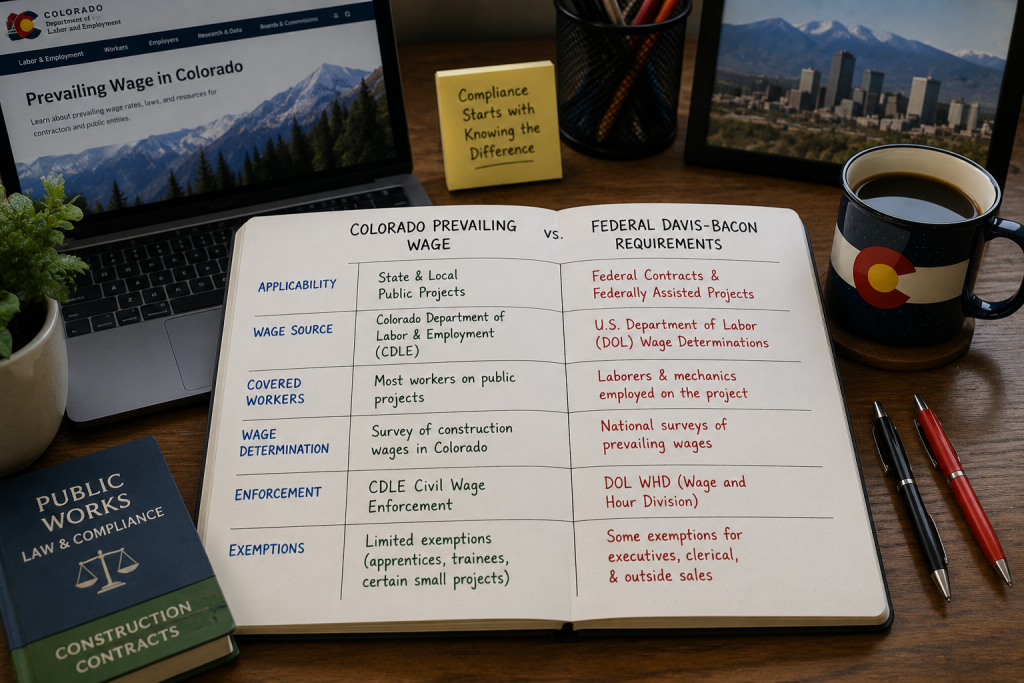

Your success on federally-funded construction projects depends on proper prevailing wage certified payroll reporting. These specialized weekly payroll reports must reach the U.S. Department of Labor on schedule, even when work stops temporarily. Miss the mark on these submissions, and you face contract funds being withheld and disqualification from future government projects.
The Davis-Bacon and Related Acts apply to your projects when federally-funded contracts exceed $2,000 for construction, alteration, or repair work, including painting and decorating. Since 1931, this legislation has required you to pay workers prevailing wages and document every payment properly. Yet construction professionals continue to struggle with these requirements, creating payment delays, audit findings, back wage assessments, and financial penalties.
Certified payroll goes beyond tracking weekly totals. You must document daily hours, allocate job time accurately when workers split across multiple projects, and handle fringe benefits correctly. The stakes remain high – non-compliance leads to severe penalties, fines, and suspension from future bids. With certified payroll reports requiring retention for at least 3 years after project completion, you need solid documentation systems to protect your business long-term.
Understanding Prevailing Wage and Certified Payroll
What exactly is “prevailing wage”? It represents the basic hourly rate plus fringe benefits paid to the majority of workers in a specific trade within a particular geographic area. When no single wage reaches majority status, the prevailing wage becomes a weighted average based on total employment within that classification.
These laws serve a clear purpose. Government contracts can’t be awarded based on paying workers less than competitors. The regulations maintain local wage standards while ensuring all contractors compete on an equal footing.
The U.S. Department of Labor determines these rates through regular wage surveys across different regions. Determinations are issued twice yearly – February 22 and August 22. Once established, rates take effect 10 days after their issue date.
Certified payroll reporting creates the documentation backbone of this system. Each weekly report must include:
- Workers’ names, classifications, and hours worked
- Wages paid (including fringe benefits)
- A signed Statement of Compliance verifying accuracy
This documentation proves contractors meet their obligation to pay workers no less than the legally required prevailing wage rates for specific work performed. The reporting requirements exist primarily to protect workers’ livelihoods on government-funded projects.
Step-by-Step Process for Certified Payroll Reporting
Accurate prevailing wage certified payroll reporting follows a methodical approach. Start by gathering essential documentation: employee information, wage rates, and payroll records.
Federal projects require Form WH-347 within seven days after each pay period. Each form demands specific information:
- Complete worker information (name, Social Security number, address)
- Proper job classifications matching the wage determination
- Daily and weekly hours worked, separated by regular and overtime
- Hourly wage rates and fringe benefits
- Gross and net wages, plus all deductions
Worker classification matters more than job titles. Pay workers based on actual tasks performed. When employees work multiple roles, track hours separately for each classification.
Calculate fringe benefits by dividing the total annual cost by the hours worked annually. You can meet fringe obligations through benefit plans, cash payments, or both.
Every submission needs a signed Statement of Compliance certifying accuracy and wage compliance. Submit reports even for weeks without work – mark them accordingly.
Retain all certified payroll records for at least 3 years after project completion. Keep them accessible for Department of Labor inspection.
Avoiding Common Mistakes and Ensuring Compliance
Worker misclassification tops the list of prevailing wage certified payroll violations. Contractors categorize employees based on convenience rather than actual work performed. This mistake alone can trigger costly back wage assessments and project delays.
Fringe benefit calculations create another major compliance hurdle. These benefits typically represent 30-40% of total prevailing wage obligations. You can fulfill fringe obligations through approved benefit plans or direct cash payments to workers.
Critical Documentation Requirements:
- Signed certification from someone who oversees wage payments and understands the work performed
- Verification that information accurately reflects all covered workers, hours, classifications, and wages
- Maintained records for at least three years after project completion for audit requirements
Prime contractors carry ultimate responsibility for subcontractor compliance on federally funded projects. This responsibility extends beyond your direct employees to every worker on the project.
Protect Your Business Today
Costly back wage assessments and potential debarment from future projects can destroy profitability. Consider booking a free discovery session related to certified payroll to learn how to avoid compliance issues and implement best practices.
Specialized certified payroll software streamlines compliance checks, automatically calculates fringe benefits, and generates completed WH-347 forms – minimizing risks while ensuring accurate reporting. Smart contractors recognize that investing in proper systems protects both current projects and future bidding opportunities.
Conclusion: Prevailing Wage Compliance Requires More Than Forms
Prevailing wage certified payroll is not a paperwork exercise. It is an operational discipline that directly determines whether public-works projects remain profitable, defensible, and repeatable for your business.
Most compliance failures do not happen because contractors are careless. They happen because prevailing wage requirements sit at the intersection of labor law, payroll, job costing, and project execution. Without specialized expertise and clearly defined processes, even experienced teams are forced to rely on assumptions, spreadsheets, and reactive fixes after problems surface.
This is where prevailing wage consulting becomes essential.
A dedicated prevailing wage consulting partner does more than review payroll reports. They assess your current labor practices, interpret agency-specific requirements, establish compliant classifications and fringe strategies, and implement repeatable reporting processes that stand up to audits. Just as importantly, they provide ongoing oversight so compliance is maintained throughout the project lifecycle, not discovered after funds are withheld or penalties assessed.
For general contractors and subcontractors working on federally funded projects, compliance is not optional, and it is not delegable. Prime contractors retain responsibility for every worker on the jobsite, including subcontractors. The cost of getting this wrong extends far beyond back wages. It impacts bidding eligibility, bonding capacity, insurance costs, reputation, and long-term growth in the public-works market.
The most successful contractors treat prevailing wage compliance as a strategic advantage. With the right consulting support, you gain confidence that labor costs are accurate, risks are controlled, and projects remain eligible and profitable from award through close-out. Instead of reacting to audits and agency findings, your team operates with clarity, documentation, and defensible processes already in place.
If you want to pursue public works projects without fear of audits, penalties, or lost opportunities, prevailing wage consulting is not an expense. It is protection for your margins, your reputation, and your ability to compete.
Learn how a focused prevailing wage consulting approach can help you implement compliant labor reporting, reduce risk, and protect profitability across every government-funded project you take on:
Schedule a free discovery session to assess your prevailing wage compliance strategy.