
Government construction contracts offer significant profit opportunities, but payroll compliance requirements can destroy your margins if handled incorrectly. Contractors face payment delays, cash flow disruptions, and unexpected compliance costs that strain project finances.
Many contractors make a critical assumption about federal requirements. They believe regulations kick in at 100 employees, when compliance actually starts at just 50 employees with qualifying contracts. This misconception creates expensive blind spots.
Contractor payroll services, federal compliance requirements, and proper worker classification protect you from penalties, contract termination, and three-year debarment from future government work. The compliance landscape changes frequently, with strict enforcement and steep financial consequences for errors.
You need to understand the requirements, master essential compliance components, and avoid the mistakes that trigger investigations. Here’s what every contractor must know to stay compliant and profitable on government projects.
Two Federal Laws Control Your Payroll Requirements
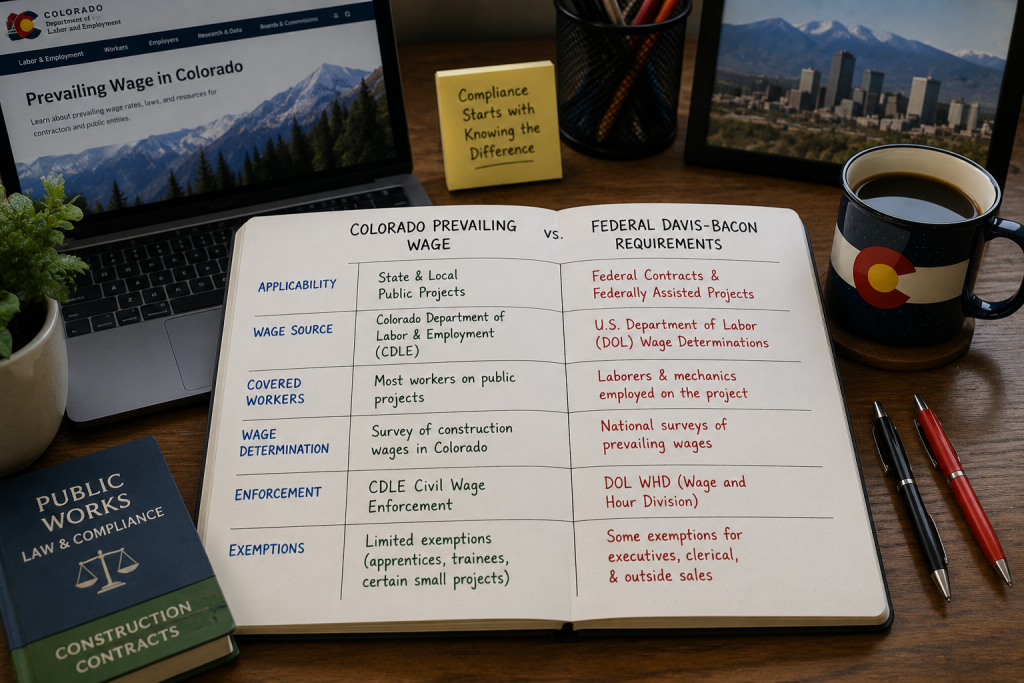
Two federal laws determine how you handle payroll on government-funded projects. Each applies to different contract types with specific thresholds.
Davis-Bacon Act
Covers construction contracts exceeding $2,000 for building, altering, or repairing public buildings or works. Approximately $200 billion in federal construction contracts flow through this system annually.
McNamara-O’Hara Service Contract Act
Addresses service contracts over $2,500, requiring contractors to pay service employees prevailing wages for work like janitorial services, security, and IT support.
Both laws mandate the same core requirement: pay workers at least locally prevailing wages, including fringe benefits, based on Department of Labor wage determinations specific to geographic location and job classification.
Compliance Goes Beyond Wage Rates
Federal contractor requirements extend far beyond paying correct wages. You must submit weekly certified payroll reports using Form WH-347 or equivalent formats. These reports document:
- Employee names and classifications
- Hours worked
- Wage rates paid
- Benefits provided
Each report requires a signed Statement of Compliance certifying accuracy and proper payment.
Record retention is mandatory. Maintain all payrolls, timesheets, wage calculations, and fringe benefit documentation for three years after project completion.
Enforcement Statistics Tell the Story
The Department of Labor concluded over 17,000 cases against employers for wage and hour violations in 2024, with construction companies facing steep penalties.
Violations trigger immediate consequences:
- Contract payment withholding
- Back wage liability
- Potential debarment from future federal contracts for three years
These penalties can destroy your business relationships with government agencies and eliminate future revenue opportunities.
Essential Components of Compliant Contractor Payroll
Compliant contractor payroll starts with one critical step: obtain the correct wage determination before you process any payroll. Wage determinations list prevailing wage rates by worker classification for specific geographic areas and construction types. These rates combine the basic hourly wage with required fringe benefits.
Sam.gov publishes both Davis-Bacon and Service Contract Act wage determinations. You must post them prominently at job sites where workers can easily see them. This isn’t optional – it’s a compliance requirement that investigators check.
Worker Classification Drives Pay Rates
Worker classification determines pay rates based on actual work performed, not job titles. If a worker performs electrician duties, you must pay the electrician rate listed on the wage determination for those hours. When workers perform multiple classifications during one week, track and pay each classification separately at the applicable rate.
Form WH-347 Requirements
The revised WH-347 form includes new fields for reporting. Besides basic employee information, you must document the Wage Determination Number, Worker Entry Number, and separate columns for Total Fringe Benefit Credit and Payment in Lieu of Fringe Benefits. Daily time records must show dates, straight time, and overtime hours worked.
Fringe Benefits Management
Fringe benefits can be satisfied through contributions to bona fide benefit plans or cash payments. Your payroll system must separate base wages from fringe amounts and document benefit plan details.
Independent contractors performing covered work must appear on certified payroll reports with proper classification and prevailing wage rates. You cannot avoid compliance by misclassifying employees as independent contractors.
Contractor Payroll Mistakes That Cost You Money
Payroll mistakes create financial exposure that goes far beyond paperwork problems. The Department of Labor collected over $1.20 billion in back wages between 2009 and 2016 from contractors who failed to comply. Here are the costly errors that trigger investigations:
1. Worker Misclassification
This violation gets the most scrutiny. Between 10% and 30% of employers misclassify at least some workers. When you label employees as independent contractors, you deny them minimum wage and overtime protections under the Fair Labor Standards Act. On prevailing wage projects, misclassifying work performed triggers violations when you pay a lower rate than required.
2. Outdated Wage Determinations
Contractors frequently use stale wage determination information for their project location. Wage rates change based on Department of Labor surveys, yet some contractors process payroll using outdated data. This creates automatic compliance violations.
3. Fringe Benefit Calculation Errors
These mistakes compound your compliance risk. Problems occur when benefits are averaged across multiple projects, paid monthly instead of weekly, or counted incorrectly on Form WH-347. Each error multiplies your potential liability.
4. Incomplete Record Keeping
Poor documentation creates audit vulnerabilities. You must maintain employee information, work hours, wage calculations, and benefit documentation for three years. Missing records make it impossible to defend your compliance efforts.
5. Multi-State Payroll Complications
Projects spanning multiple states add complexity through varying tax withholding requirements, unemployment insurance obligations, and local wage laws. Federal contractor compliance requirements demand timely weekly certified payroll submissions within seven calendar days after regular payday.
Construction payroll services with specialized Davis-Bacon expertise minimize these errors through automated compliance systems and regulatory tracking. The cost of prevention is always less than the cost of violations.
The Path Forward
Managing contractor payroll on government projects requires precision, consistency, and the right systems behind you. The difference between confidence and constant risk comes down to how well your processes are built and executed.
When your approach is structured correctly, you gain more than compliance. You gain control over your margins, clarity in your operations, and confidence in every project you take on. Your team moves faster, decisions become easier, and your business becomes more predictable and scalable.
But most teams do not struggle because they lack effort. They struggle because the process is fragmented, unclear, or built on assumptions that do not hold up under real scrutiny. That is where costly mistakes begin.
The opportunity in front of you is simple. Build a system that works before problems appear, not after they surface.
If you want to strengthen your approach, reduce risk, and create a more reliable path to profitable projects, the next step is a focused conversation.